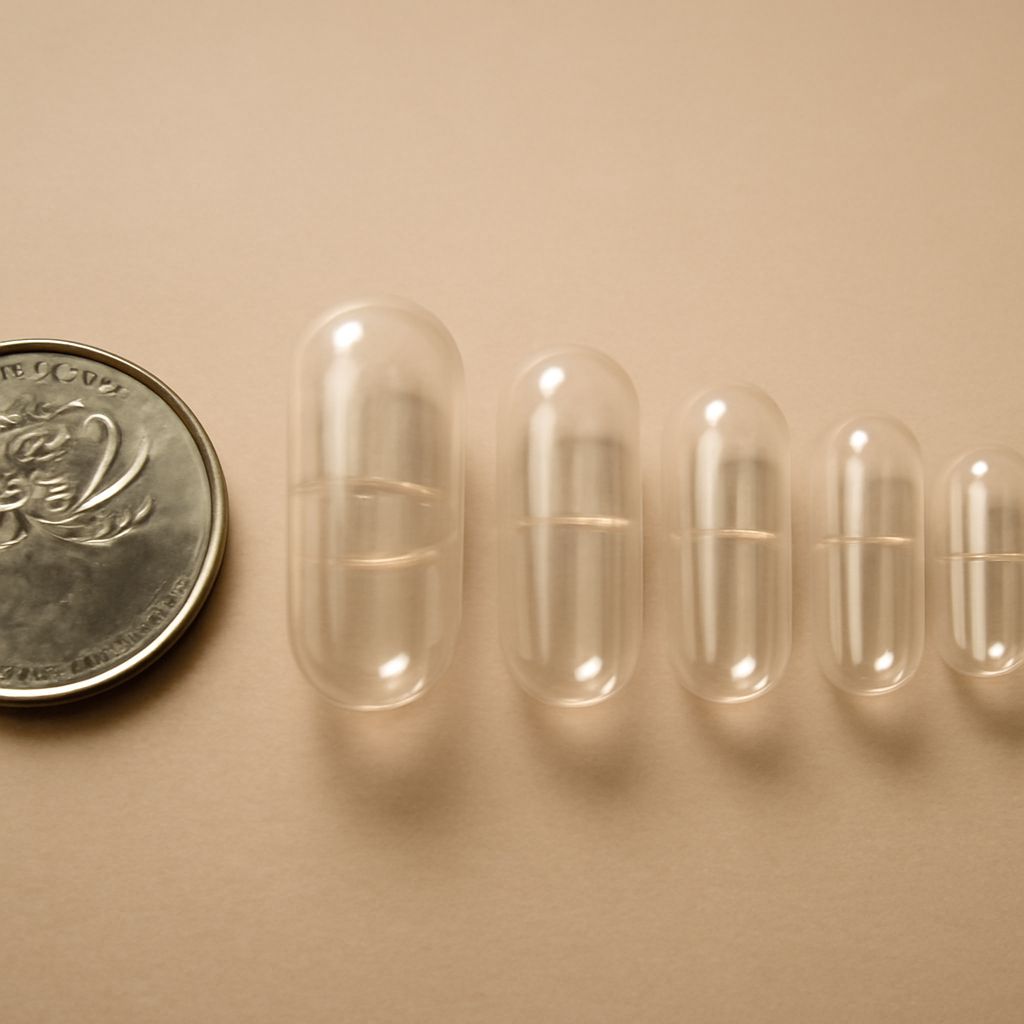
Capsule Size Chart mg: From Size 000 to Size 4 Explained
Whether you are compounding your own supplement blends, sourcing capsules for a health product, or just curious about medication fill amounts, understanding the capsule size chart mg is essential information. Capsule sizes follow a standardized numbering system that can be counterintuitive—smaller numbers (or 0s) indicate larger capsules. Navigating the difference between a 000 capsule size, a capsule size 00, what a 00 capsule actually holds, and the capacity of a size 1 capsule helps you make accurate formulation decisions.
How the Capsule Size Chart Works
The capsule sizing system used in the pharmaceutical and supplement industry is standardized across manufacturers. Capsules range from the largest (size 000) down to the smallest commonly used sizes (size 4 or 5). The fill volume—measured in milliliters—determines how many milligrams of a substance can be encapsulated, though the actual mg weight depends on the density of the fill material. A dense mineral like calcium carbonate fills a capsule by weight much more efficiently than a light, fluffy herb powder of the same volume.
Numbering System Explained The capsule numbering convention goes: 000 (largest), 00, 0, 1, 2, 3, 4 (smallest common size). This inverse relationship between number and size surprises many first-time buyers. Size 000 is used for large doses of bulky ingredients, while size 4 is appropriate for highly concentrated, potent formulations where only a small amount of active ingredient is required. Understanding this inverse scale is the foundation of reading the capsule size chart correctly.
Factors That Affect Fill Weight
The mg capacity of any capsule size is not a fixed number—it varies based on the bulk density of the fill material. Dense powders like mineral salts pack more mass per milliliter than light botanical powders. Tapping and vibration during filling compact loose powders and can increase fill weight by 15–30% compared to unfilled estimates. When designing a supplement formulation, calculating the target dose and the bulk density of your active ingredient together determines which capsule size is appropriate.
Capsule Size 000 and 00: Large-Capacity Options
The two largest standard capsule sizes—000 and 00—are primarily used for large-dose supplements and compounded medications requiring high ingredient volumes per dose.
000 Capsule Size Volume and mg Range
The 000 capsule size has a fill volume of approximately 1.37 milliliters. In practical terms, this translates to roughly 800–1,600 mg of fill depending on powder density. A 000 capsule is the largest standard hard-shell capsule routinely used in human supplement manufacturing. It is sometimes described as a “horse capsule” due to its size—and many patients find it challenging to swallow. For powders with low bulk density, such as certain fiber supplements or lightweight herb extracts, 000 may be necessary to achieve the target dose per capsule.
Capsule Size 00 Typical mg Fill A capsule size 00—often written simply as “double-oh”—has a fill volume of approximately 0.91 milliliters. Typical fill weights range from 500 to 1,000 mg depending on ingredient density. The 00 capsule is the most widely used size in the supplement industry, offering a balance between dose capacity and swallowability. Most standard over-the-counter vitamin and mineral supplements use 00 capsules, and it is the default size referenced when capsule fill instructions do not specify otherwise.
Size 0, Size 1, and Smaller Capsule Options
Size 0 capsules have a fill volume around 0.68 mL, accommodating approximately 400–800 mg of typical powders. They are easier to swallow than 00 or 000 sizes, making them a preferred choice when dose size allows. A size 1 capsule has a fill volume of approximately 0.50 mL and typically holds 300–600 mg of powder. Size 1 capsules are commonly used for pediatric formulations or lower-dose supplements where compactness improves patient compliance.
Size 2 capsules (around 0.37 mL) and size 3 (around 0.30 mL) are used for smaller doses and highly potent active ingredients. Size 4 capsules (approximately 0.21 mL) are the smallest routinely used in human applications, appropriate for highly concentrated extracts or essential oils. Veterinary applications may use even smaller sizes for pets, with size 5 capsules available for very small animals.
Choosing the Right Capsule Size for Your Formulation
Selecting the correct capsule size requires knowing your target dose in milligrams, the bulk density of your fill material, and any patient population considerations. Start by calculating the fill volume needed: divide the target dose (mg) by the bulk density (mg/mL) of your ingredient. Compare this to the fill volumes in the capsule size chart to identify the smallest capsule that accommodates the required volume.
Capsule material is another consideration—standard gelatin capsules are widely available and economical, while vegetarian (HPMC) capsules are required for vegan and some religious dietary markets. Colored and printed capsules are available for product branding. Working with a qualified compounding pharmacist or contract manufacturer when developing a new supplement formulation ensures that capsule sizing, fill weight, and product specifications are validated before production begins.
Key takeaways: Capsule sizes follow an inverse numbering system where 000 is the largest and 4 is the smallest common size. Actual mg fill depends on the bulk density of the ingredient, not just the capsule volume. The 00 capsule is the most widely used size in supplement manufacturing, balancing dose capacity with practical swallowability.