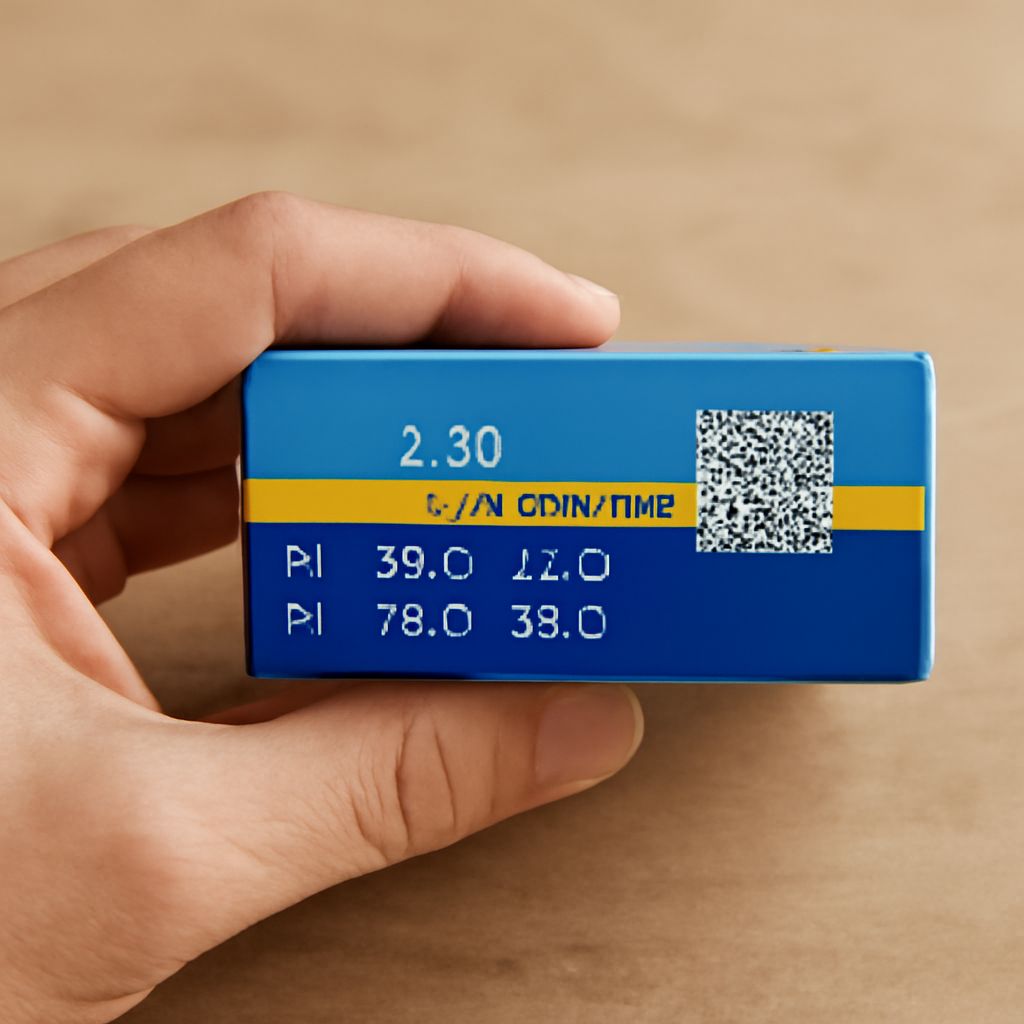
How to Read a Contact Prescription: Numbers, Meaning, and Lens Differences
Understanding how to read contact prescription documentation is a practical skill that helps you order lenses accurately, compare prices across retailers, and catch entry errors before they affect your vision. A contact lens prescription meaning differs from a glasses prescription in ways that matter for lens ordering, and knowing how to read a contact lense prescription, including what each abbreviation and number represents, prevents the frustration of receiving the wrong lenses because of a transcription error.
Contact prescription numbers include several parameters not found on a glasses prescription. These additional values reflect the physical requirements of a lens sitting directly on the cornea rather than positioned in a frame at a specific distance from the eye. Learning how to read contact prescription details, including parameters like base curve and diameter, helps you understand what you are ordering and why each parameter matters.
How to Read Contact Prescription: The Key Parameters
A contact lens prescription includes the following parameters for each eye: power (PWR or SPH), base curve (BC), diameter (DIA), and for toric lenses that correct astigmatism, cylinder (CYL) and axis. Some prescriptions include add power for multifocal lenses. Each parameter serves a specific function in ensuring the lens fits correctly and provides accurate vision correction.
The power or sphere value on a contact prescription is the same corrective power concept as on a glasses prescription, but the numeric value may differ slightly. Because contact lenses sit on the cornea rather than 12 millimeters in front of the eye, the effective corrective power changes for higher prescriptions. For prescriptions above +/- 4.00 diopters, the contact lens power is adjusted to account for this vertex distance difference. Lower prescriptions often show the same value on both glasses and contact prescriptions.
Base curve is a parameter unique to contact prescriptions. It describes the curvature of the back surface of the lens, which must match the curvature of the cornea closely enough that the lens centers properly and moves with the blink without causing discomfort or poor vision. BC values are expressed in millimeters. A typical base curve range is 8.3 to 9.0 millimeters, though this varies by lens brand and design. Using a lens with the wrong base curve can cause discomfort, poor vision, or inadequate oxygen transmission to the cornea.
Contact Lens Prescription Meaning: What Each Number Tells You
Diameter (DIA) specifies the total width of the contact lens from edge to edge. Standard soft contact lenses have diameters in the range of 13.8 to 14.5 millimeters. The diameter value determines how far the lens extends onto the sclera beyond the corneal edge, affecting centration and comfort. Specialty lenses like scleral lenses have much larger diameters, often 15 to 20 millimeters, covering the entire cornea and resting on the sclera rather than the corneal surface.
For patients with astigmatism needing toric contact lenses, the contact prescription numbers include cylinder and axis values. The cylinder value represents the power difference between the two principal meridians of the astigmatic correction. The axis specifies the orientation of the cylinder, measured in degrees from 1 to 180, just as in a glasses prescription. Toric contact lenses have a stabilization design that prevents the lens from rotating on the eye and maintaining the axis alignment; if the lens rotates, vision will be blurry despite correct power values.
The brand and lens type are also specified on contact prescriptions because parameters like base curve and diameter are brand-specific. A Dailies AquaComfort Plus lens cannot be substituted with an Acuvue Oasys lens using the same power, base curve, and diameter values from one brand prescription, because the brands have different fitting characteristics. Contact prescriptions are brand-specific documents, which is one reason why switching brands requires a new fitting evaluation.
How to Read a Contact Lense Prescription for Ordering Online
Ordering contact lenses online requires entering each prescription parameter exactly as written on your prescription document. Contact prescription abbreviations used online ordering forms may differ slightly from what appears on your paper prescription: PWR and SPH both refer to sphere power, CYL refers to cylinder, AX or AXIS refers to axis, BC refers to base curve, and DIA refers to diameter. If an online form uses an abbreviation you do not recognize, check the form help section or call customer service rather than guessing.
Online retailers are required by the Fairness to Contact Lens Consumers Act to verify your prescription with your prescribing doctor before filling the order. Some retailers verify automatically through electronic records; others call your doctor office. If your prescription has expired, the retailer cannot legally fill the order. Contact lens prescriptions expire after one to two years depending on state law and the prescriber policy, and the expiration date appears on the prescription document.
Double-checking the contact prescription numbers you entered before submitting an online order is worth the thirty seconds it takes. Transposing digits in the base curve or entering the wrong axis value for a toric lens results in lenses that do not fit or correct vision properly. The cost of returning incorrect lenses and reordering is greater than the time spent verifying entries before submission.
When Contact Prescription Numbers Differ from Your Glasses Prescription
Finding that your contact prescription numbers differ from your glasses prescription is expected and not a sign of an error. For prescriptions in the lower power ranges, the values may be identical or very close. For prescriptions with sphere values above plus or minus 4.00 diopters, the contact power will be adjusted from the glasses prescription power to account for the vertex distance difference mentioned earlier. A glasses prescription of -5.00 might appear as -4.75 on the contact prescription, for example.
The cylinder and axis values may also differ between glasses and contact prescriptions. Glasses can correct astigmatism precisely because the lens position relative to the eye is controlled by the frame. Contact lenses move with blinks and may rotate slightly, which affects the effective cylinder correction delivered to the eye. Some patients who have low astigmatism on their glasses prescription find that a spherical, non-toric contact lens provides adequate vision because their eye adapts to the minor residual astigmatism. Others require toric lenses to achieve acceptable vision quality.
If you are confused about why your contact prescription differs from your glasses prescription, asking your optometrist or ophthalmologist to explain the difference during your contact lens fitting appointment is entirely appropriate. Understanding your own prescription parameters gives you confidence when ordering and helps you notice if a prescription is entered incorrectly by a retail or online dispensing staff member.