Plano Eye Prescription: What PL Means and How to Read the Axis
Plano Eye Prescription: What PL Means and How to Read the Axis
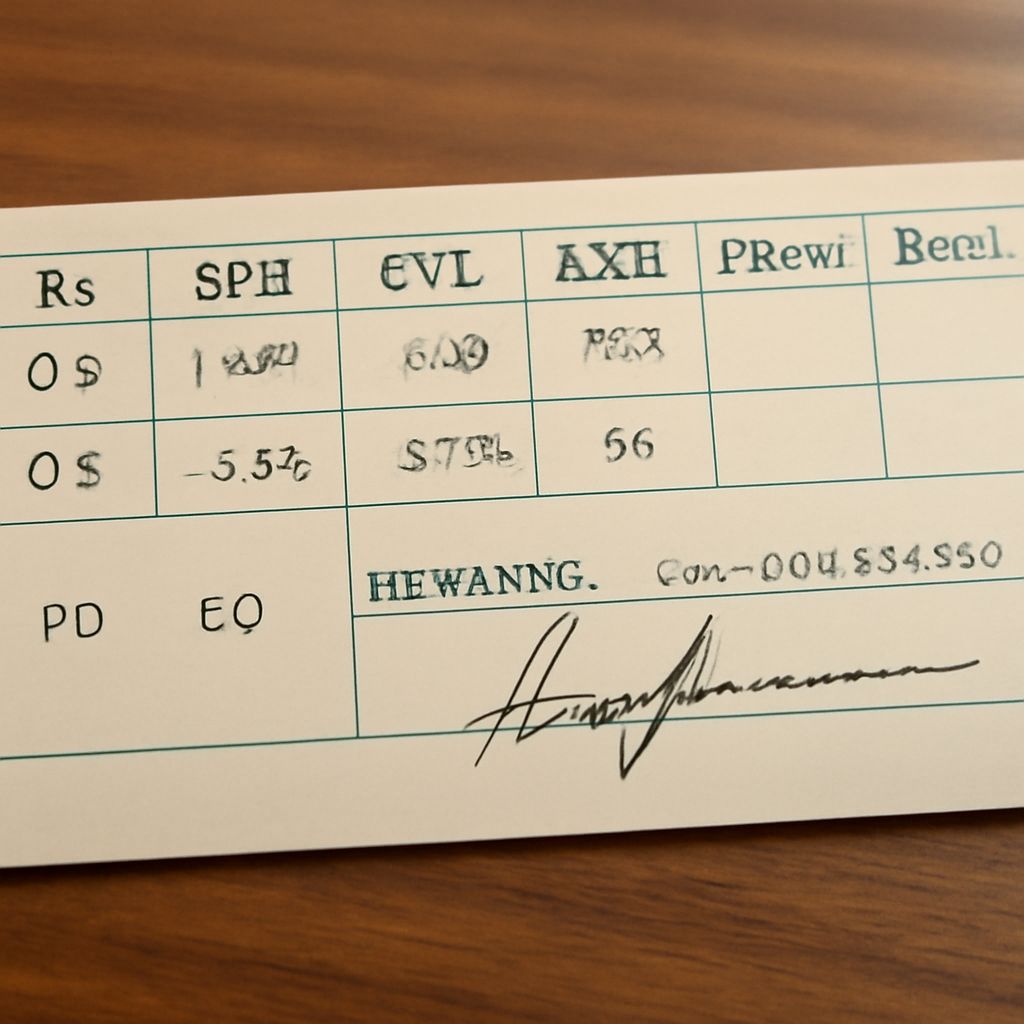
An eye prescription looks like a table of abbreviations and numbers that most patients receive without explanation. A plano eye prescription has a specific meaning that differs from what people often assume. What does pl mean on eye prescription? It means plano—zero correction for that eye or that column. What does plano mean in eye prescription terms? It indicates no refractive error for the sphere or cylinder component where the notation appears. Eye prescription plano notation shows up on prescriptions for people who have no significant farsightedness or nearsightedness in one or both eyes but may still need astigmatism correction or a reading add. Eyeglass prescription axis is the companion value to the cylinder column that tells the lab exactly where to orient the cylindrical correction in the lens.
Understanding these terms lets you verify your prescription before ordering glasses and ask smarter questions at your next eye exam.
What Plano Means in an Eye Prescription
Where Plano Appears on the Prescription Form
A plano notation replaces a zero or near-zero sphere value in the prescription table. It appears in the OD (right eye) or OS (left eye) row under the SPH (sphere) column. When the sphere is plano, it means the eye does not need correction for distance or near vision through spherical power.
The presence of a plano eye prescription entry does not mean the prescription is blank or that glasses are unnecessary. A cylinder (CYL) value may still appear alongside a plano sphere, meaning the person needs correction for astigmatism only.
Reading an eye prescription plano entry alongside other values in the row gives the full picture. For example, PL / -0.75 / 90 in one row means: no sphere correction, -0.75 diopters of cylinder for astigmatism, oriented at 90 degrees (the axis).
What Does PL Mean in Different Contexts
Some prescriptions write “PL” while others write “0.00” or “Pl”—all mean the same thing. The abbreviation comes from the Latin planus meaning flat, referring to a flat (non-curved) lens with no power. Opticians and optical labs treat PL and 0.00 identically when grinding lenses.
Understanding what PL means on an eye prescription is particularly useful when ordering glasses online, where you must enter sphere values manually. Many online ordering forms accept “0.00” but not “PL” as a text entry—enter 0.00 when you see a plano notation.
Eyeglass Prescription Axis: What the Number Means
Reading Axis Values Correctly
The eyeglass prescription axis is a number from 1 to 180 degrees that defines the orientation of the cylindrical correction in the lens. It only appears when there is a CYL value present—if the cylinder is blank or zero, no axis is needed.
An axis of 90 means the cylindrical power runs vertically in the lens. An axis of 180 means it runs horizontally. Any value in between describes a diagonal orientation. The axis is not a power measurement—it tells the lab which direction to apply the astigmatism correction.
Entering the axis incorrectly when ordering glasses is one of the most common causes of blurry or uncomfortable new lenses. Even being off by 5 to 10 degrees can cause noticeable visual distortion for prescriptions with significant cylinder values.
Plano with an Axis: What It Means
A prescription that shows plano in the sphere column but still has a cylinder and axis is correcting pure astigmatism with no accompanying farsightedness or nearsightedness. This combination is valid and relatively common. The lens will be flat in one meridian and curved in the perpendicular meridian, with the orientation set by the axis value.
When both the sphere and cylinder are plano (or 0.00 / 0.00), no corrective power is needed for that eye. A prescription may still be written for that eye if the other eye requires a lens, since glasses frames require both lenses to maintain structure and balance.
Next Steps After Receiving Your Prescription
Review your written prescription before leaving the optometrist’s office. Confirm that all values are legible, that both OD and OS rows are complete, and that the prescription is signed and dated. If plano appears and you are unsure whether it means the eye needs correction, ask the technician to clarify before you order. When ordering online, translate any PL notations to 0.00 and double-check the cylinder and axis values against your paper copy before submitting the order. Keeping a copy of your prescription allows you to verify what was entered if you receive lenses that do not feel correct.